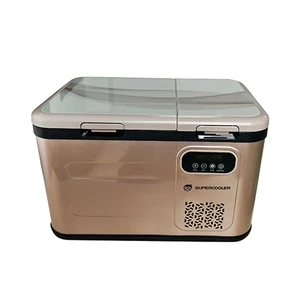
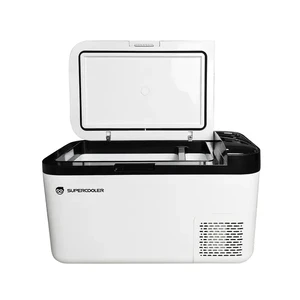
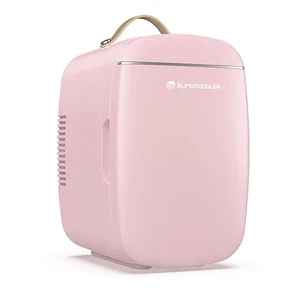
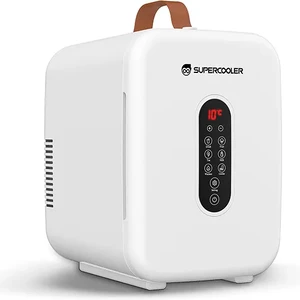
Ever had one of those moments—You pack all your carefully prepped ingredients, only to realize they don't even fit in the cooler. You lug an "empty" box up the hill, already out of breath. You pop open the lid at camp, and the ice has already turned into a puddle of water.
That beef that was perfectly fresh last night? Now it's giving off a faint, funky smell. Or worse— One bump on the road, and your cheap foam cooler shatters. White foam bits mix in with your food. And that meal? Ruined. These aren't rare mishaps.
They happen every single summer to countless campers, anglers, and road-trippers. What's the real problem? It's the cooler.
This guide is written by the team at SuperCooler's factory—a 16-year veteran in the industry. We're breaking down, from production know-how and real test data, what actually makes a reliable outdoor cooler worth your trust.
PART 01 | The Real Pain Points That'll Drive You Crazy
Pain Point 1: "Capacity" That's Basically a Lie
A cooler labeled 50 liters? Its actual usable space might be just 35 liters. The other 15 liters get eaten up by wall thickness and internal structure. You plan your grocery list perfectly for a family camping trip. Then comes packing time— Nothing fits. It's not that you bought too much. It's that the number on the box was flat-out misleading.
Pain Point 2: Heavy When Empty, a Nightmare When Full
Some coolers weigh over 11 pounds—empty. Load them up with food and ice, and you're easily hauling 40+ pounds. That walk from the parking lot to your campsite? Every step is pure suffering. A good cooler should save your energy for what actually matters.
Pain Point 3: Overhyped Ice Retention—This Is the Biggest Scam
This is where customers get burned the most, and it's the easiest claim to fake. A brand says "Keeps ice for 72 hours"— But that's in a lab. Constant 77°F, packed with ice water, sitting perfectly still. Real life? Summer heat at 104°F. Lid opened and closed repeatedly. Only half-filled with ice. Sitting in direct sun for two hours. That "72-hour" cooler? Might not even last the afternoon. Spoiled food isn't just wasted money. Out in the wild, it's a food safety hazard.
Pain Point 4: Cheap Foam Coolers—Are They Saving You Money or Making More Trouble?
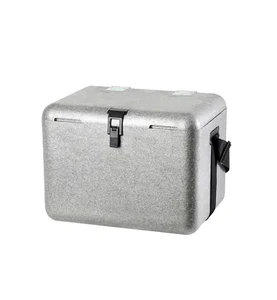
A foam cooler for twenty bucks. One bump and it cracks. White foam bits stick to everything. It barely holds ice for half a day. And after one use, it's just non-biodegradable trash.
Cheap is its only selling point. And that "advantage" disappears after the very first trip. All four of these pain points lead to one conclusion: A cooler isn't about being cheap. It isn't about being big. It's about being professional. And professional means materials, craftsmanship, data— and 16 years of hard-earned engineering know-how.
PART 02 | Choosing a Cooler? Start With These 4 Core Metrics
Before you even look at styles or prices, get these four things straight.
01 Ice Retention—Look at the Test Standard, Not the Hype
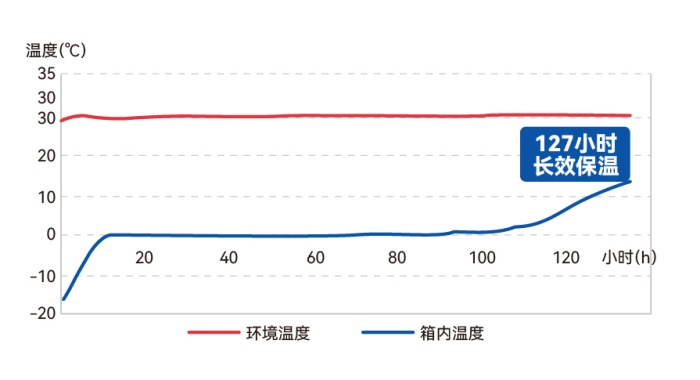
The "ice retention" numbers you see online? A lot of them are pure fluff. The gold standard: EN12571 European Test Standard. Test conditions: Ambient temp at 86±2°F, filled to the brim with ice-water mixture (32±2°F), measuring how long it takes to reach 50°F. This is the most credible global benchmark for cooler performance. Under this standard, a quality cooler can deliver 24–72 hours. The SuperCooler SPV-IB-50L vacuum cooler? It clocked 176 hours under EN12571—that's over 7 days. That's not marketing fluff. That's lab-tested data.
Buying Tips:
1–2 day camping trips: Go for 24–48 hour models.
3–5 day road trips: Choose 72+ hour models.
Cold-chain / medical use: Pick 120+ hour models, paired with PCM phase-change materials.
02 Sealing Performance—Insulation Starts With "Airtight"
You can have the best insulation material in the world. But if the seal isn't tight, cold air will still leak out.
A competent seal design should have at least:
Food-grade silicone gasket that stays elastic and doesn't deform.
Tight closure between lid and body with no gaps.
Premium models with dual gaskets or latch locks.
Quick in-store check:
03 Usable Capacity—Don't Fall for "Liter" Numbers
Labeled capacity ≠ actual usable capacity. Wall thickness, internal ribs, and drainage channels all eat up real space. Some brands calculate capacity from external dimensions. Your actual usable space could be 20–30% less.
Buying Tips:
Personal use: 6–12L portable models.
Family camping (3–4 people): 30–50L.
Commercial / group events: 60L+ stackable models.
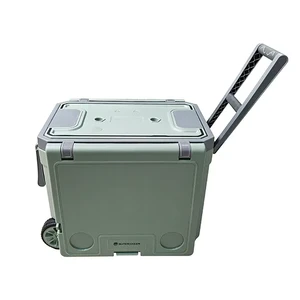
Road trips: Prioritize wheeled or towable models—your back will thank you.
04 Food Safety—The Inner Liner Is Non-Negotiable
The inner liner that touches your food? It must meet food-grade PP/PE standards.The problem with cheap liners isn't just the smell.Long-term use can mean harmful chemicals leaching into your food. Simple sniff test: Open the lid and take a deep breath. Smell strong plastic fumes? Move on. A proper food-grade liner should be odorless or have only the faintest plastic scent.
PART 03 | Material Matters—What's the Difference Between a $30 and $300 Cooler?
Cooler prices range from pocket change to premium. About 90% of that difference comes down to one thing: what's in the middle layer.
Outer Shell: Determines Durability
Material | Features | Best For |
Rotomolded / Blow-molded | One-piece construction, impact-resistant, handles extreme temps | Harsh outdoor conditions, heavy-duty use |
EPP (Expanded Polypropylene) | Lightweight, eco-friendly, high impact resistance, recyclable | Urban use, lightweight-focused users |
Standard Injection-molded | Low cost, brittle, not durable | Not recommended for outdoor use |
Inner Liner: Determines Safety
Food-grade PP/PE is the baseline—not a bonus feature. Odorless, withstands -4°F to 176°F, easy to clean, won't trap grime. Cheap coolers often use industrial-grade plastics. Long-term use? That's a health risk you don't want to take.
The Insulation Core: This Is Where the Magic Happens
This is the most critical—and most overlooked—part.
EPS (Expanded Polystyrene) Foam
Thermal conductivity: ~0.036 W/(m·K)
Ice retention: 8–24 hours
Fragile, absorbs moisture, performance drops fast
Price: Low
Polyurethane (PU) Foam
Thermal conductivity: ~0.022–0.035 W/(m·K)
Ice retention: 24–72 hours
The mainstream mid-to-high-end solution
Price: Mid-range
VIP (Vacuum Insulation Panel)
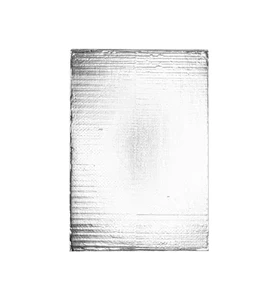
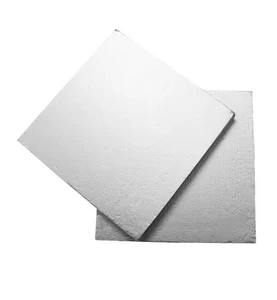
Supertech VIP panels achieve thermal conductivity as low as 0.002 W/(m·K) (custom lower-conductivity VIPs available)
Ice retention: 72–176+ hours
At the same thickness, VIP insulates 6–8x better than PU foam
Price: High value for money, top-tier performance
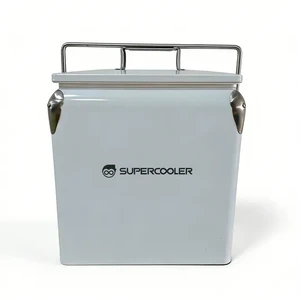
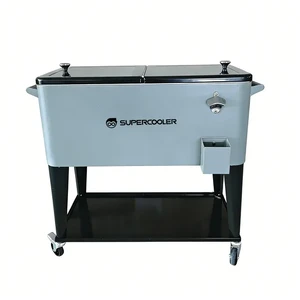
Same wall thickness? A SuperCooler cooler with VIP panels delivers 6–8x the insulation of a regular PU cooler. Someone else's cooler holds ice for 1 day. SuperCooler holds ice for a full week. Not because the walls are thicker. But because the material is simply better.
Why is VIP Vacuum Insulation so powerful? The principle is actually simple: Vacuum is the best insulator. No air means no heat transfer through convection or conduction. Supertech VIP panels use a high-vacuum process to remove almost all air from the core material, completely cutting off heat conduction paths.
Supertech VIP panels also use a high-performance barrier film rated for a 15-year lifespan. This film has an extremely low gas transmission rate, effectively blocking moisture and oxygen from seeping in—keeping the internal vacuum stable over the long haul.
This technology was originally developed for aerospace and medical cold-chain applications.SuperCooler, backed by parent company Supertech's 16 years of vacuum insulation expertise, brings this professional-grade tech to everyday outdoor use.
Heads-up: Cheap coolers almost always use plain foam cores. Not only does retention suffer, but the foam can crumble and mix with your food. If the price is too low, you can bet it's not using VIP panels.
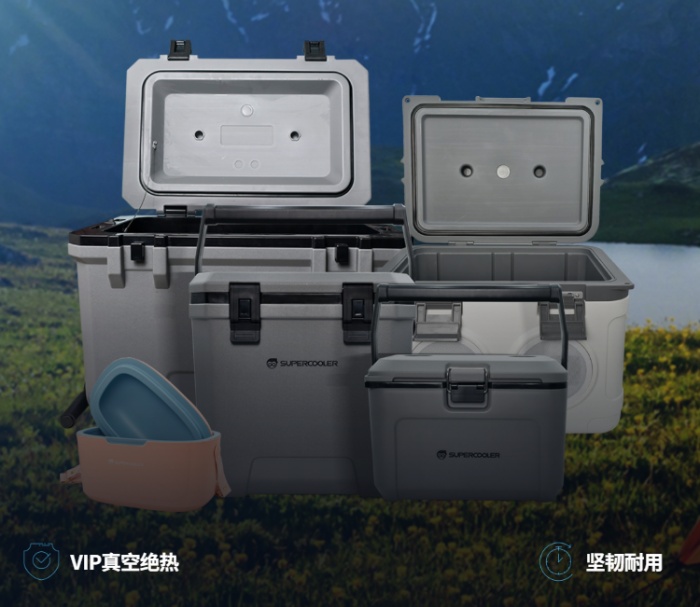
PART 04 | Why Choose SuperCooler? 5 Real Reasons That Make a Difference
01 Full 5-Side VIP Coverage
Not partial. Not single-sided. SuperCooler embeds VIP panels in all 5 sides of the cooler. 360° no-blind-spot insulation. No weak point for heat to break through.
02 Ice Retention—Backed by Hard Numbers
Model | Tested Ice Retention | Standard |
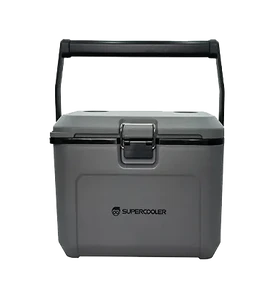
SPV-IB-50L | 176 hours | EN12571 |
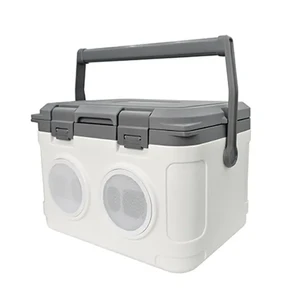
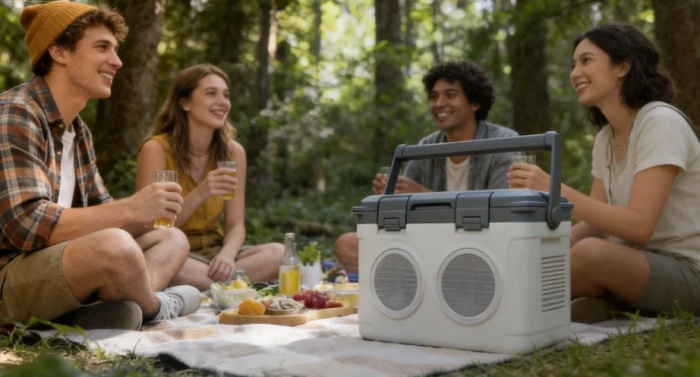
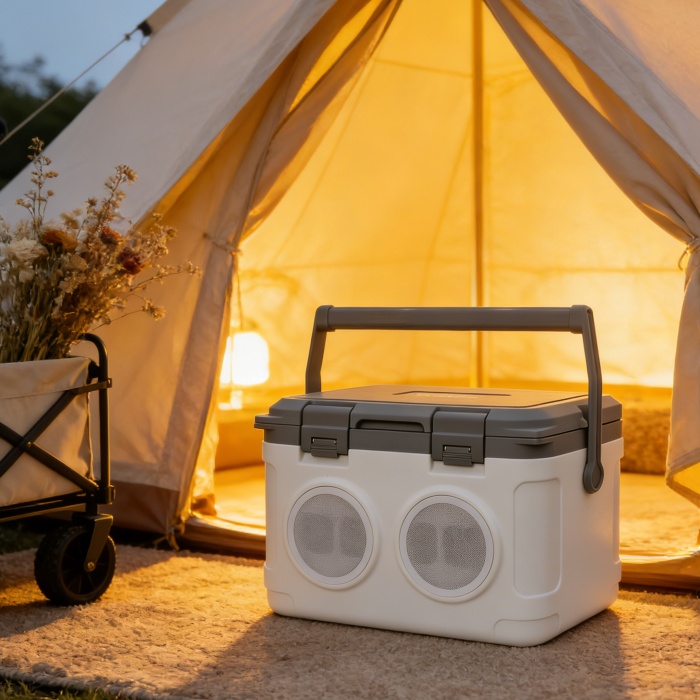
SPV-BIB (Bluetooth Speaker Model) | 127 hours | EN12571 |
Standard Series | 72+ hours | EN12571 |
All data are from real EN12571 tests. Not theoretical lab fluff. Verifiable. Real. Trustworthy.
03 Lightweight Design—We Don't Make You Choose Between Performance and Portability
Better insulation doesn't have to mean a heavier cooler. One of VIP's biggest advantages: at the same insulation level, it's only 1/5 to 1/10 the thickness of traditional materials.
Thinner walls mean:
That walk from the parking lot to camp? You'll thank us.
04 Food Safety—Zero Compromises
Inner liner: Food-grade PP, odor-free, rated from -4°F to 176°F.
Gasket: Food-grade silicone, stays elastic, easy to remove and clean.
Outer shell: Eco-friendly materials, no harmful substances.
You're storing food in it. Safety isn't a "feature"—it's the bare minimum.
05 Built for Every Scenario—One Cooler, Endless Uses
Recreation & Outdoor
Weekend camping/picnics: Keep 2–3 days of food and drinks fresh.
Kayak fishing/angling: Keep your catch cold until you're back at shore.
RV life: Maintains cold without draining your vehicle's battery.
Urban & Everyday
Local grocery delivery: Simple cold-chain support for fresh goods.
Farmers' markets / night stalls: Sell cold drinks and meals with no electricity.
Save money on buying ice over and over—pays for itself in the long run.
Professional & Specialized
Remote job sites: Store drinking water and emergency meds.
Medical cold-chain: Transport insulin, reagents, and small-batch temperature-sensitive items.
Events & team sports: Marathon aid stations, group bike rides, and more.
PART 05 | Do the Math—What Does a Good Cooler Actually Save You?
A lot of people think a premium cooler is too expensive. But let's run the numbers—you might change your mind.
Cost 1: Spoiled Food
One camping trip with spoiled food because your cooler failed? That's $20–$100+ down the drain. Four to five trips in a summer? That adds up to more than the price of a quality cooler.
Cost 2: Ice Expenses
Regular coolers lose ice fast—so you keep buying more. A bag of ice costs $3–$5.One trip might need 3–5 bags. SuperCooler's VIP insulation lasts 6–8x longer than regular coolers. Same ice, way more mileage.
Cost 3: Lifespan
Cheap foam coolers? Dead after one or two uses. SuperCooler with metal-encapsulated VIP panels? Performance stays stable for years. One investment. Years of use. Spread that cost over every trip, and it's actually cheaper in the long run.
Cost 4: If You're Running a Side Business
A cooler that holds temperature for 12+ hours with no electricity? That's your core business tool. One failure means lost inventory—and lost customer trust. That math? It's a no-brainer.
PART 06 | FAQs—Straight Answers
Q1: How should I actually read ice retention claims?
A: Look for EN12571 test data. At 95°F ambient, paired with PCM phase-change materials, SuperCooler can sustain 120+ hours (36–46°F).
Q2: What's the real difference between SuperCooler and regular coolers?
A: One word: the core. The difference is the insulation layer. SuperCooler uses Supertech VIP panels with thermal conductivity as low as 0.002 W/(m·K)—that's 4–6x better than traditional PU foam. Same wall thickness, 6–8x the insulation. Standard models deliver at least 72 hours.
Q3: What sizes are available?
A:
6L, 12L: Personal portable—lunchboxes, short trips.
13–22L: Beach/picnic days, fishing.
21–35L: Camping, family outings.
50L: BBQ parties, group events.
60L+: Commercial cold-chain, stackable models.
Q4: Can these be used in a vehicle?
A: Absolutely. SuperCooler SAV-KM series includes a 12/24V DC cord (car) and 110–240V AC cord (home). Some models even support app-based temperature control.
Q5: Any tips before first use?
A:
For cold use: Pre-cool the cooler in a shaded spot 1–2 hours ahead, or toss in a small amount of ice to chill the inner walls. This significantly extends actual retention time.
For hot use: Pre-heat the interior with hot water or heat packs. Keep temperatures below 176°F.
Maintenance: After each use, remove the gasket, wash it separately, and let it dry completely to prevent bacterial growth.
Q6: Can the VIP panel get damaged?
A: Supertech VIP panels are housed in a metal-shell enclosure. Under normal use, they stay stable and won't fail from compression or minor bumps. Just avoid puncturing the walls with sharp objects.
A perfect camping trip needs more than good weather and great company. It needs a cooler that— when you pop the lid— still delivers that satisfying chill. That ice-cold beer at the summit. That fresh catch after a day on the water. That ice cream your kid pulls out at the campsite. Those moments deserve a cooler that actually works.
SuperCooler, backed by parent company Supertech's 16 years of vacuum insulation expertise, delivers factory-direct quality to over 20 countries worldwide. We don't make "good enough" coolers. We make the one you'll trust to open every single time.